
Data-driven targeting for
results-driven sports brands
Connect with the right people, every time

Audience targeting that drives more clicks, calls and sales
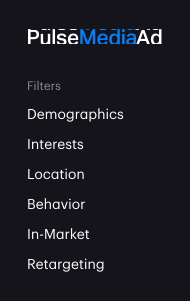
Get custom-built sports audience segments with all the attributes of your ideal customer
Reach your audience with unmatched accuracy
Precision audiences that drive results
Custom Audience Segment
Real-time audience optimization
Bring back visitors. Boost conversions.
Results you can measure
Audience Targeting
Retargeting
Explore more
Network
Context
Frequently asked questions
What is audience targeting?
Audience targeting involves segmenting website users based on data such as demographics, interests, browsing history, location and other factors to find specific target audiences. This strategy ensures that ads are shown to individuals who are interested in the products or services offered, improving conversion rates and reducing wasted ad spend.
What are the benefits of AI and machine learning?
AI targeting results in more precise targeting, improved engagement, enhanced personalization, increased efficiency, and more conversions. AI can predict which ads, audiences and placements will be most effective, and can optimize ad serving in real-time, resulting in better return on ad spend.
What’s the difference between audience targeting and contextual targeting?
Audience targeting finds an audience based on demographic and behavioral data to create audience segments for specific target audiences. Ads are served that are relevant to the user.
Contextual targeting matches ads with relevant content to ensure the ads are aligned with the brand and the offer. Ads are served based on the content of the webpage.
We typically combine both methods for maximum campaign effectiveness.
How does audience targeting work without cookies?
Some browsers are phasing out 3rd-party cookie tracking. This means that behavioral advertising will be more restricted in the coming years. Marketers will need to adjust by embracing new targeting methodologies such as contextual targeting and the use of AI and machine learning.
Where does the audience targeting data come from?
Our audience data is generated using a combination of third-party data and AI & machine learning algorithms. The data providers develop audience groups, gather raw data, and aggregate it. The aggregated data is processed to train the machine learning models and build custom predictive audiences that are most likely to convert, consistently outperforming other solutions.
Because the data is anonymized, the audience data is reflective of domains, not individual users.